Decorative Concrete Ideas for Driveways and Patios in Stockton
Plain gray concrete does the job. It holds up under vehicle weight, it drains correctly, and it lasts for decades. But it does nothing for the way your home looks from the street or the way your backyard feels when you are sitting in it.
Decorative concrete does both. Same material, same structural performance, but with color, pattern, and finish that turns a functional slab into a design feature. And unlike pavers or natural stone, it comes in as a single continuous pour without joints to weed, individual pieces to shift, or a price tag that puts the project out of reach for most homeowners.
Here are four real ideas from projects Drago Inc. has built in the Stockton area, covering driveways, patios, walkways, and accent features, along with what actually makes each approach work.
List of Services
-
Idea 1: Bold Stamped Walkways and Patio in a Deep Terracotta ColorItem Link List Item 1
Best for: Homeowners who want a backyard that makes a statement and holds its visual weight against fencing, landscaping, or an existing home exterior.
In one project we completed locally, we installed stamped concrete across both the patio and the connecting walkway in a deep, warm terracotta orange. The color was consistent throughout, running from the back of the house across the patio surface and along the walkway that leads through the yard.
The result is a space that reads as intentionally designed. The terracotta tone picks up the warm undertones common in California stucco homes and connects the outdoor surface to the house in a way a gray slab never would. Walking from the back door across this patio does not feel like stepping onto a construction material. It feels like stepping into a finished outdoor room.
Dark, warm colors like this work particularly well in Stockton backyards because they hold up visually in bright sun without washing out. Lighter colors can look faded in intense summer light. A deep terracotta holds its richness through the season.
What to consider:Deeper colors require a quality sealer applied correctly to protect the pigment from UV fading. In Stockton's sun, resealing on a regular schedule, typically every two to three years, is more important with bold color choices than with neutral tones. The color you see at installation is only as permanent as the maintenance behind it.
-
Idea 2: Light Beige Stamped Patio with Dark Brown Borders, Decorative Rock, and TurfItem Link List Item 2
Best for: Homeowners who want a complete backyard finish that combines multiple materials into a cohesive design rather than a collection of separate elements.
This is one of the more complete backyard transformations we build regularly. In a project we completed in the Stockton area, we poured a stamped concrete patio in a soft, warm beige with a darker brown border running the perimeter of the slab. The border detail frames the patio visually and gives the space a finished edge rather than a raw concrete line meeting the yard.
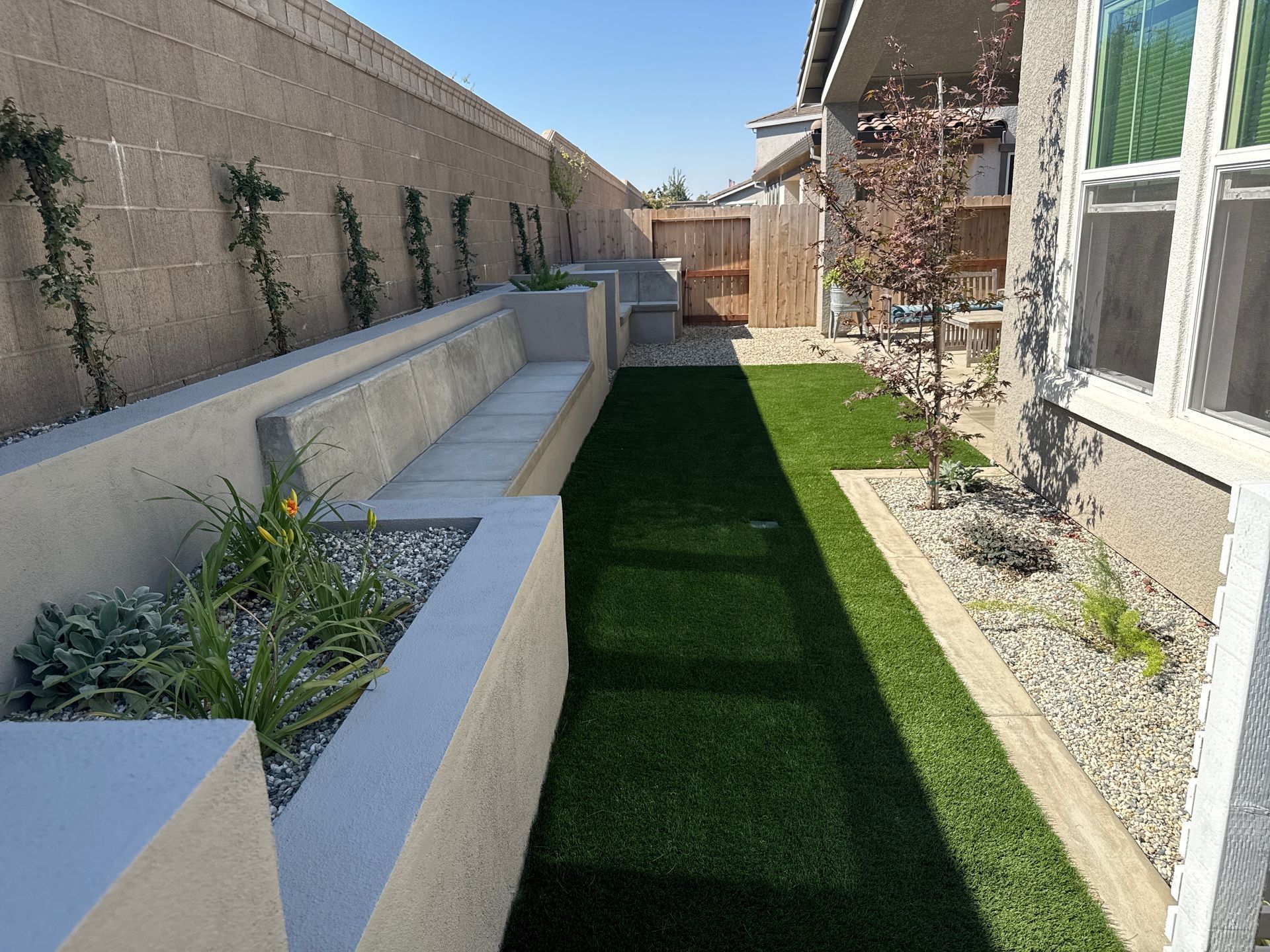
Beyond the concrete itself, the project incorporated decorative rock and artificial turf into the surrounding yard space. The three materials work together: the beige concrete reads as neutral and open, the dark brown border grounds it, and the rock and turf fill in the surrounding landscape so the entire backyard is finished rather than just the patio being upgraded in isolation.
This combination is particularly effective in Stockton because it addresses the full backyard in one project rather than leaving sections unfinished. A beautiful patio surrounded by dead grass or bare dirt undermines itself. When the concrete, rock, and turf are planned and installed together, the result is a backyard that looks complete from every angle.
What to consider: The two-tone approach, a field color plus a contrasting border, requires planning during the pour. The border is typically done with a different color hardener applied while the concrete is still workable. This is a detail that needs to be discussed at the design stage, not added as an afterthought. Make sure your contractor has experience with two-tone applications before committing to this look.
Thinking about a decorative concrete driveway or patio in Stockton? We can show you color samples, pattern options, and walk your property before you commit to anything.
Call us at
(209) 871-8110 or
request a free estimate online.
List of Services
-
Idea 3: Stamped Decorative Concrete DrivewayItem Link
Best for: Homeowners who want to upgrade their curb appeal without replacing the driveway structure entirely, or those building a new driveway and want something that stands out from the standard gray slabs on the street.
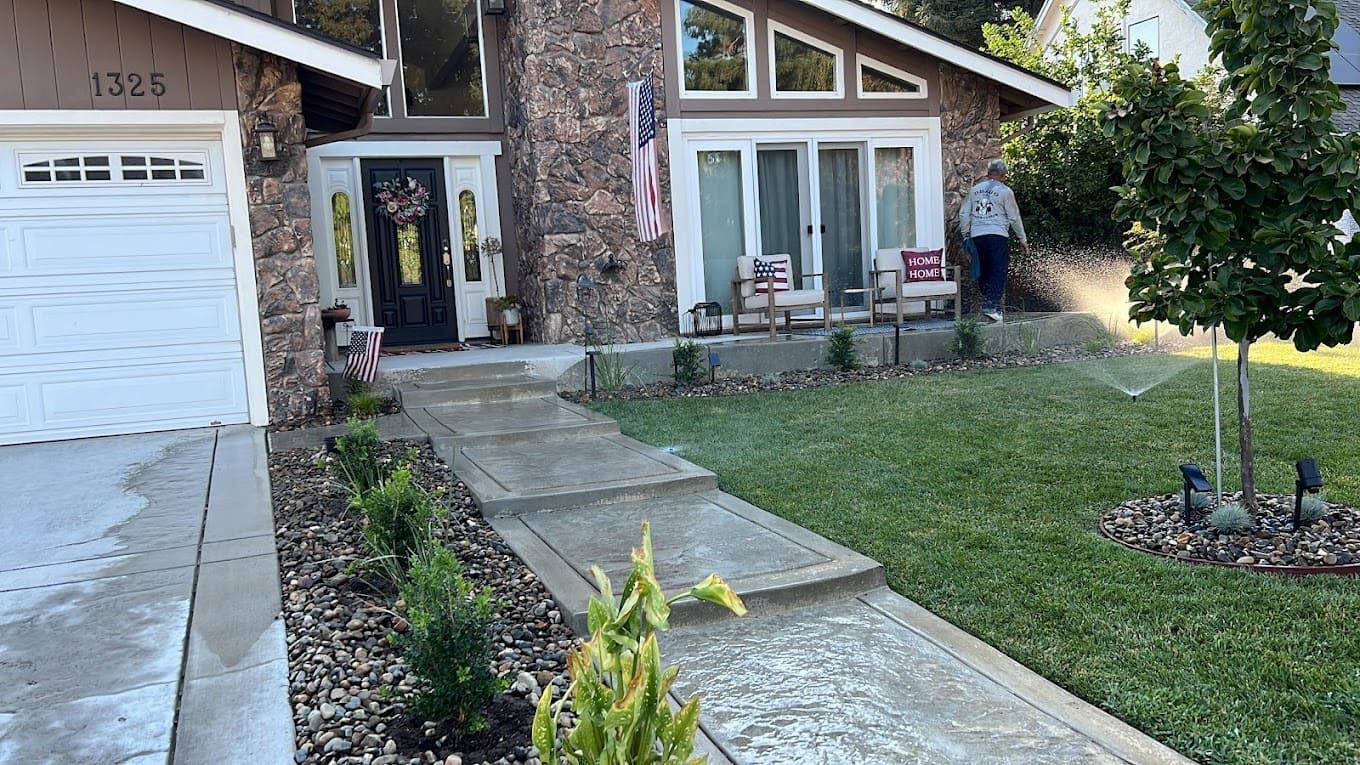
A decorative concrete driveway is one of the highest-visibility upgrades a homeowner can make because it is the first thing anyone sees when they approach the house. In a project we completed locally, we installed a stamped decorative concrete driveway that replaced what had been a standard utilitarian surface with something that reads as a deliberate design choice rather than a default.
The pattern and texture of the stamp carries most of the visual weight here. Common options we use on driveways include slate texture, cobblestone, wood plank, and large-format tile patterns, each of which gives a distinctly different character to the finished surface. The right choice depends on the architectural style of the home, the surrounding landscaping, and the homeowner's preference for how formal or casual the front of the house reads.
From a structural standpoint, a decorative driveway is built exactly the same way as a standard one: proper base compaction, correct slab thickness for the vehicle load, rebar reinforcement, and the right PSI concrete mix. The decorative elements are applied during the pour, not after, so the structural integrity of the slab is not affected by the finish.
What to consider: Driveways take more abuse than patios, vehicle weight, oil, and weather cycles all affect the surface over time. A quality sealer applied correctly is especially important on a decorative driveway because it protects both the color and the surface texture from the wear that comes with daily vehicle use. Ask any contractor specifically about the sealer product they use on driveways and how often it needs to be reapplied.
-
Idea 4: Stamped Concrete Accent Feature on a Patio Corner in Tan with Lighter BordersItem Link
Best for: Homeowners who want to add a decorative element to an existing or new patio without doing a full decorative pour across the entire surface.
Not every decorative concrete project needs to cover the entire patio. In one project we built locally, we incorporated a stamped concrete accent in a warm tan tone with lighter borders as a corner feature on a patio. The decorative section occupied one portion of the outdoor space, creating a defined focal point without requiring the entire slab to be stamped.
This approach works well when the homeowner wants to introduce decorative concrete into the design without the full cost of stamping the entire surface, or when an existing concrete patio is in good condition and only a portion of the space is being redesigned. The accent feature draws the eye to a specific area, like a seating corner or the space around an outdoor kitchen or fire feature, and gives that section a distinct character.
The tan and lighter border combination in this project created a soft, warm tone that reads well in outdoor light without competing with surrounding landscaping or furniture. Tan is one of the most versatile color choices for patios because it works with a wide range of home exteriors, from warm stucco tones to cooler gray or white finishes.
What to consider:When decorative concrete is used as an accent alongside a plain concrete section, the transition between the two areas needs to be handled cleanly. A defined border, a change in elevation, or an edge detail between the decorative and standard sections prevents the two finishes from looking mismatched. This is worth discussing at the design stage so the layout accounts for the transition from the start.
Choosing the Right Color for Stockton's Climate
Color choice is not just aesthetic. In Stockton's climate, it has practical implications worth understanding before you commit.
Darker colors absorb more heat in direct sun. A deep terracotta or charcoal concrete surface will be noticeably warmer underfoot on a 100-degree afternoon than a lighter surface. For patios where you will be walking barefoot, this matters. For driveways, it matters less since you are typically walking across quickly rather than sitting on the surface.
Lighter colors reflect more heat but show staining and tire marks more readily on driveways. A light beige driveway that looks beautiful at installation will show oil spots and tire rubber more visibly than a darker surface over time. Sealing helps significantly but does not eliminate this entirely.
Mid-range tones, warm tans, sandy beiges with contrast borders, and muted terracotta shades, tend to hit the best balance between heat performance, stain visibility, and long-term appearance in this climate. They are also the most versatile in terms of matching a wide range of home exterior colors.
Decorative Concrete vs Plain Concrete: Is It Worth It?
The short answer for most Stockton homeowners is yes, with one condition: the decorative elements have to be maintained.
The upfront cost difference between plain concrete and stamped decorative concrete depends on the complexity of the pattern and the color choices, but for most residential projects the premium is not dramatic relative to the total project cost. The bigger variable is the ongoing maintenance. Decorative concrete that is resealed on schedule looks great for decades. Decorative concrete that is neglected fades, loses its texture definition, and eventually looks worse than plain concrete would have.
If you are willing to reseal every two to three years, decorative concrete is a strong investment. If you want a completely hands-off surface, plain concrete is the more honest recommendation.
Request a Decorative Concrete Estimate in Stockton
If you are thinking about a decorative driveway or patio, we can show you pattern and color options, walk your property, and give you a detailed estimate based on what you actually want to build.
Drago Inc. serves Stockton, Manteca, Tracy, Lodi, Lathrop, and surrounding communities throughout San Joaquin County.
Call us at (209) 871-8110 or request a free estimate online.
Frequently Asked Questions
-
What is decorative concrete?
Decorative concrete is standard concrete that has been finished with color, texture, or pattern during or immediately after the pour. Stamped concrete is the most common form, where tools are pressed into the surface while it is still workable to create patterns that mimic brick, slate, stone, wood, or other materials. Color is added through integral pigments in the mix or through color hardeners applied to the surface.
-
How long does decorative concrete last?
A properly installed and maintained decorative concrete surface lasts 25 years or more. The structural lifespan of the concrete itself is the same as plain concrete. The decorative finish, color and surface texture, lasts as long as the sealer protecting it is maintained. Resealing every two to three years in Stockton's climate is the standard recommendation.
-
Does decorative concrete crack?
Yes. Concrete of any type can crack, and decorative concrete is no exception. Control joints are cut into slabs during installation to direct where cracking occurs if it happens. Proper base preparation, correct slab thickness, and appropriate reinforcement minimize cracking risk. Cracks in decorative concrete are more visually noticeable than in plain concrete because of the color and pattern, which is a trade-off worth knowing going in.
-
Is decorative concrete slippery when wet?
The texture from the stamping process actually gives decorative concrete more grip than a smooth troweled surface. Broom-finished plain concrete and stamped concrete both provide more traction when wet than a polished or smooth finish. Sealer can reduce grip slightly, particularly if over-applied, which is why the right sealer product and application method matters for outdoor surfaces.
-
How much does decorative concrete cost compared to plain concrete?
Decorative concrete typically costs more per square foot than plain concrete due to the additional labor, color materials, and stamps involved. The exact difference depends on pattern complexity, color choices, and project size. This is approximate and varies by project, so compare actual detailed quotes rather than relying on a per-square-foot estimate for budgeting purposes.
-
What patterns work best for driveways?
Slate texture, large-format tile, cobblestone, and wood plank patterns are all commonly used on driveways in the Stockton area. The right choice depends on the architectural style of the home and the homeowner's preference for how formal or casual the finished surface reads. We walk through pattern options at the estimate stage so the choice is made with the full context of your specific property in mind.
-
Can decorative concrete be added to an existing patio?
If an existing concrete patio is structurally sound, an overlay system can be applied to add texture and color without a full tear-out and repour. This is a different scope than a fresh stamped concrete pour and has different performance characteristics. If the existing slab has structural issues, cracks, or drainage problems, an overlay will not fix the underlying problem and a full replacement is the right approach.
Drago Inc. is a licensed (CSLB #1017023) and insured concrete contractor serving Stockton, Manteca, Tracy, Lodi, Lathrop, and surrounding San Joaquin County communities since 2016. Learn more about our concrete patio services or contact us for a free estimate.
Share Now!