Front Yard Landscaping Ideas for Stockton Homeowners
Most front yard landscaping content is written for places that get regular rain, mild summers, and easy-draining soil. Stockton is none of those things.
We hit 100 degrees for weeks at a time. The soil is dense clay that holds water all winter and cracks by August. Water bills add up fast. And whatever you put in your front yard needs to survive without a lot of attention.
The ideas below are built around those realities. Every one of these designs has been done by Drago Inc. on Stockton properties. Some use turf, some use concrete, some use gravel and plants. All of them look good, hold up in this climate, and keep maintenance manageable.
1. Artificial Turf with Concrete Curbing and Planting Borders
This is the most requested front yard design we do right now, and the reasons are pretty simple. You get the look of a green lawn without the water bill, the mowing, or the dead patches every August.
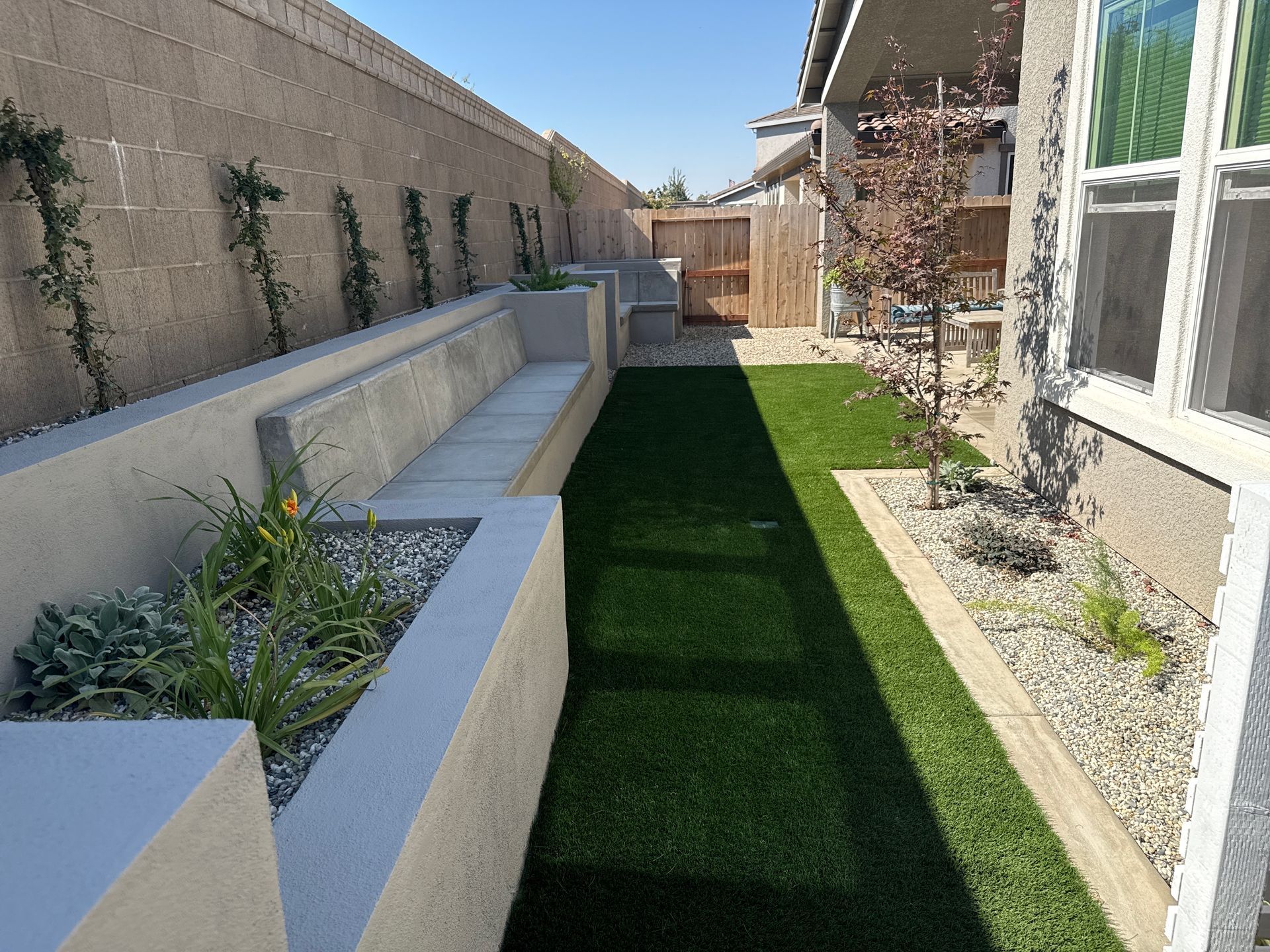
The execution matters more than most people expect. The best versions of this design use concrete curbing to create clean edges between the turf and planting beds, then fill the beds with white or grey gravel and one or two ornamental trees or shrubs. The contrast between deep green turf and light gravel gives the yard a polished, finished look that holds up over time.
In Stockton's clay soil, base preparation under the turf is not optional. Without a compacted decomposed granite base and adequate drainage, the clay will hold moisture under the turf and create soft spots or odor problems over time. Done right, a turf front yard in Stockton requires almost no maintenance and looks the same in October as it did in May. That is why artificial turf installation in Stockton has become one of our most requested services.
Natural grass in the Central Valley needs consistent watering from May through September just to survive. Turf eliminates that completely. The upfront cost is higher than sod, but most homeowners see that difference offset within two to three years through lower water bills.
2. Decomposed Granite with Concrete Borders and Low-Water Plants
For homeowners who want a landscaped look without turf, decomposed granite with concrete borders is one of the most practical options for Stockton front yards.
The design uses concrete edging to define planting zones, then fills the open areas with compacted DG in a natural tan or grey tone. Drought-tolerant plants, ornamental grasses, or small accent trees go into the defined beds. The result looks intentional and well-kept, not bare or unfinished.
DG holds up well in the heat, does not wash away in winter rain if it is properly compacted and edged, and needs almost no upkeep once it is installed. It also handles heat better than dark mulch, which matters when your front yard faces southwest in a 105-degree summer.
Good plant choices for Stockton front yards in this style: Mexican sage, lavender, rosemary, ornamental grasses like blue fescue or Karl Foerster, and dwarf Japanese maples for a focal point near the entry. All of these handle the heat, need very little water once they are established, and look good in both summer and winter.
3. Concrete Driveway Apron with Integrated Landscaping
One of the most overlooked front yard upgrades in Stockton is treating the driveway and the landscaping as one connected project rather than two separate ones.
A widened concrete driveway apron that flows into a bordered planting bed along the property edge creates a cohesive look that most front yards in Stockton lack. The concrete provides a clean, durable anchor, and the landscaping fills the remaining space with low-maintenance texture and color.
This works especially well on properties where the front yard is narrow or the driveway takes up a lot of the space. Rather than cramming grass or gravel into whatever is left, you design around the driveway as a feature.
One practical note: concrete driveways hold up better than asphalt in the Central Valley's heat. Asphalt softens in extreme heat and develops ruts and cracks faster in conditions like Stockton's. A properly installed concrete driveway in Stockton will outlast asphalt by decades with basic maintenance, which is why most homeowners we work with go concrete when they are doing a full front yard redesign anyway.
4. White Gravel Planting Beds with Ornamental Trees
This is the design that photographs well on a listing and holds up best over five to ten years with minimal effort.
The concept is straightforward: define one or two planting beds along the house foundation or property edge, fill them with white or light grey river gravel, and plant one or two ornamental focal trees with a few low-growing shrubs around the base.
White gravel does a few things that other ground covers do not. It reflects light instead of absorbing heat, which helps plants survive Stockton summers. It suppresses weeds more effectively than bark mulch, which breaks down over time. It does not blow around or wash away. And the contrast between white gravel and dark concrete curbing or a green focal tree is one of the cleanest looks you can get in a low-maintenance front yard.
Japanese maples work really well for this design in Stockton, especially the darker red varieties. They are deciduous so they look different in winter, but their fall color is excellent and they do not need much water once they are established. Ornamental plum trees work similarly. For something evergreen, a lemon tree or small olive tree adds texture year-round.
5. Stamped Concrete Walkway as the Entry Feature
A well-designed front walkway sets the visual tone of a property before anyone reaches the door. In Stockton's climate, stamped concrete is one of the best materials for this because it handles heat expansion, requires minimal maintenance, and looks better than a plain broom-finished slab.
A stamped walkway in an ashlar slate or flagstone pattern, framed on both sides by gravel beds or low-growing ground cover, creates a clean entry that improves curb appeal more than almost any single change. Paired with concrete curbing along the planting areas and a consistent color palette, it brings the whole front yard together.
Colors that work well in Stockton's light conditions: warm tan, grey, and sandstone tones. Darker colors absorb heat and get uncomfortable to walk on in bare feet during summer, so we typically steer clients away from those. The finish and pattern range for stamped and decorative concrete in Stockton is wide enough that most homeowners find something that fits their style without having to go custom.
6. Turf Strips with Concrete Stepping Slabs
For properties where a full turf conversion is not the goal, turf strips combined with concrete stepping slabs create a design that is more interesting than a standard lawn while still being low-maintenance and water-efficient.
The concept uses narrow bands of artificial turf between concrete stepping slabs, or around a defined path, rather than covering the entire yard. This works well on smaller front yards where a full turf installation would feel heavy, and on properties where the homeowner wants to keep some open ground area without the water and maintenance commitment of natural grass.
This is the same design principle we use in pool surround projects: concrete slabs with turf filling the joints and borders. Applied to a front yard, it reads as modern and clean, and it holds up in Stockton's climate without any ongoing irrigation once the turf is properly installed.
A Few Things to Think About Before You Start
- HOA rules: Many Stockton neighborhoods, especially newer subdivisions in the north and south, have HOA rules about front yard landscaping, turf, and hardscape percentages. Check before committing to a design.
- City water restrictions: Stockton and San Joaquin County periodically put watering restrictions in place that can affect how much you can water new plants in the first few weeks after installation. If your design includes live plantings, timing matters.
- Clay soil drainage: Any hardscape project in Stockton needs to account for water drainage. Water that cannot drain away from the foundation causes long-term problems. A good contractor evaluates grade and drainage as part of every project, not as an afterthought.
- Permit requirements: Significant hardscape additions, such as certain curbing heights or major driveway expansions, may require permits from the City of Stockton. Your contractor should identify what requires a permit before work starts.
Our landscaping services in Stockton cover all of the above, from design through permits through installation.
FAQ: Front Yard Landscaping in Stockton
-
What is the best low-maintenance front yard landscaping for Stockton's climate?
Artificial turf with concrete curbing and gravel planting beds is the most maintenance-free option for Stockton front yards. It eliminates mowing, dramatically reduces watering, and holds its appearance through the hottest summers. Decomposed granite with drought-tolerant plants is a strong alternative for homeowners who prefer a more natural look. Both options outperform natural grass in Stockton's heat and water cost conditions.
-
How much does front yard landscaping cost in Stockton?
Describe the item or answer the question so that site visitors who are interested get more information. You can emphasize this text with bullets, italics or bold, and add links. -
Is artificial turf a good choice for front yards in Stockton?
Yes, and it is one of the most practical choices for the Central Valley specifically. Natural grass in Stockton requires sustained irrigation from May through September just to stay alive. Artificial turf eliminates that water demand completely. Modern turf products are UV-stabilized for high-heat climates, hold their color through multiple summers, and look significantly better than dying natural grass in August. The key is proper base preparation, especially in Stockton's clay soil, which is why an experienced installer matters.
-
Do I need a permit for front yard landscaping in Stockton?
Most landscaping work does not require a permit. The exceptions are concrete work near the public right-of-way, retaining walls over 4 feet, and certain driveway modifications. A licensed contractor will flag what requires a permit before starting and handle the application process. Unlicensed contractors often skip permits, which can create problems when you sell the property.
-
What plants hold up best in Stockton front yards?
For low-water, low-maintenance front yard planting in Stockton: lavender, Mexican sage, rosemary, ornamental grasses like blue fescue or Karl Foerster, Japanese maple, dwarf crape myrtle, and ornamental plum trees. All of these tolerate the heat and require minimal water once they are established. Avoid anything that needs consistent summer irrigation without a drip system in place.
-
How long does a front yard landscaping project take?
Most residential front yard projects in Stockton take one to three days once materials are on-site. Projects that include concrete work require curing time before the surrounding landscape is completed. Permit timelines, when required, add time before work can start. Your contractor should give you a realistic timeline in writing at the estimate stage.
Ready When You Are
Most of the front yards we work on in Stockton started with a homeowner who just wanted to stop dealing with dead grass and a high water bill. The finished project usually ends up being something they are genuinely proud of, not just something that is easier to maintain.
If you have a rough idea of what you want, or even just a problem you want solved, that is enough to start. We come out, look at the space, talk through what makes sense for your property and your budget, and put it in writing.
Drago Inc. is a licensed (CSLB #1017023) and insured concrete contractor serving Stockton, Manteca, Tracy, Lodi, Lathrop, and surrounding San Joaquin County communities since 2016. Learn more about our concrete patio services or contact us for a free estimate.
Share Now!