Signs Your Concrete Driveway Needs Replacement
Most homeowners do not think about their driveway until something is obviously wrong. By the time a crack is wide enough to catch your eye from the street or a section has sunk far enough to scrape your car bumper, the question is no longer whether there is a problem. The question is how serious it is and what it is going to cost to fix it.
Some driveway problems are legitimate repair candidates. Others look repairable on the surface but have underlying issues that make repair a short-term band-aid on a long-term problem. Knowing the difference saves you from spending money on repairs that fail within a few years and puts you in a position to make a decision based on what is actually happening with your slab, not just what it looks like on top.
Here is how to read what your driveway is telling you.
Sign 1: Cracks That Are Wide, Deep, or Growing
Not all cracks are equal. This distinction matters more than most homeowners realize.
Hairline cracks are narrow surface cracks, typically less than a quarter inch wide, that develop as concrete cures and settles in its first few years. They are extremely common and in most cases cosmetic. A stable hairline crack that has not changed in size or direction for years is not a structural concern.
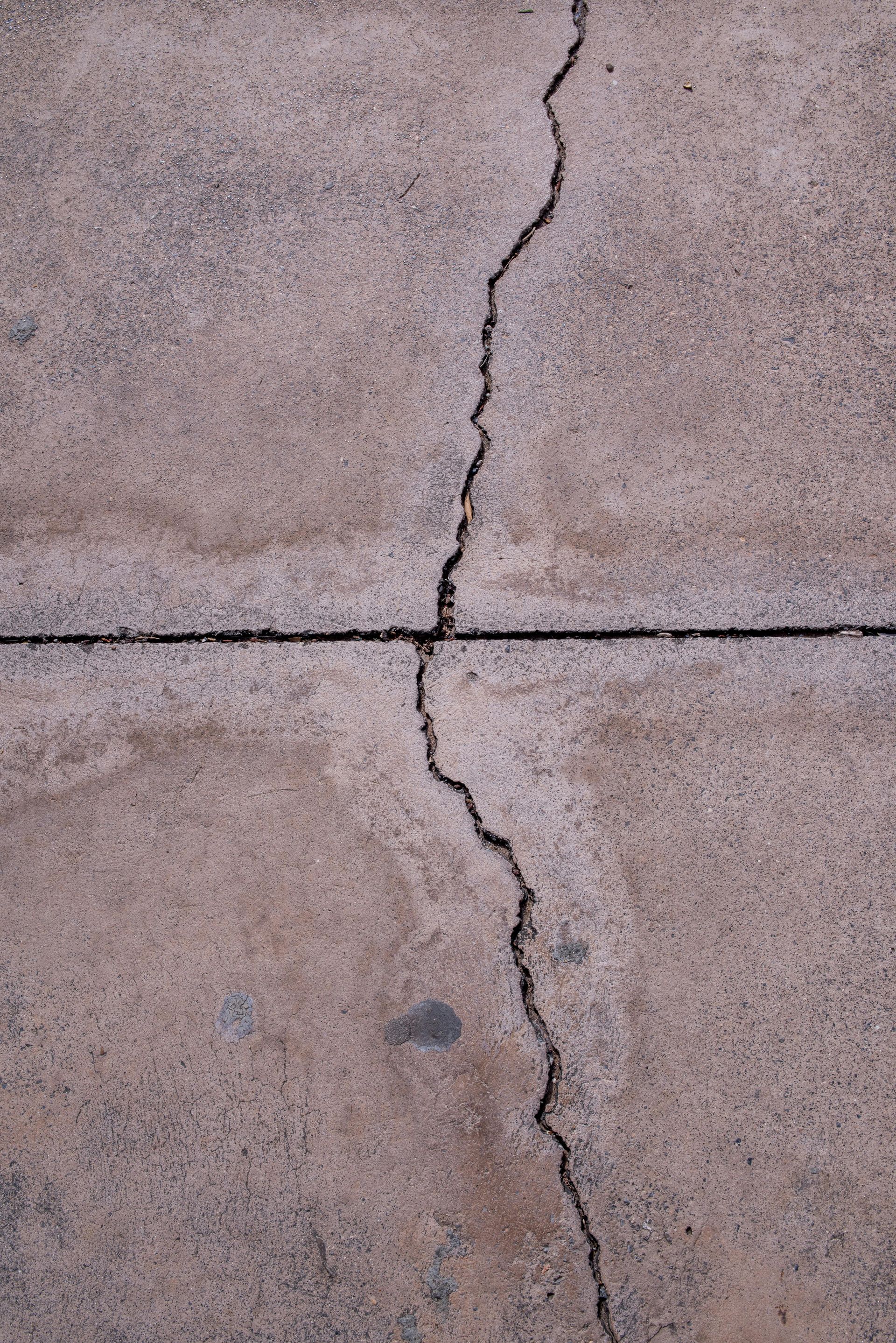
Wide or deep cracks are a different category entirely. Cracks wider than a quarter inch, cracks that have visible depth when you look into them, or cracks that you can feel as a ridge or drop when you run your hand across them indicate structural movement in the slab. These cracks allow water to enter the concrete, work into the base below, and accelerate the failure of both the slab and the foundation beneath it.
Growing cracks are the most telling sign of all. If you have a crack that was smaller last year than it is today, or one that has extended further across the slab since you first noticed it, the forces causing it have not stabilized. A crack that is actively growing is not a repair candidate in the conventional sense because the slab is still moving.
What this tells you: Wide, deep, or growing cracks are a strong indicator that the slab has structural issues. Surface patching fills the visible gap but does not stop the movement causing it. In most cases, cracks of this nature in a driveway that is more than 15 to 20 years old point toward replacement rather than repair.
Sign 2: Multiple Cracks Across the Surface
A single crack in an otherwise sound driveway is a different situation than a driveway that has developed cracks in multiple locations across the surface.
When cracking is widespread, the slab as a whole is under stress. This pattern typically indicates one of three things: the base beneath the slab has shifted significantly, the slab was poured too thin for the loads it has been carrying, or the concrete mix used during installation was not strong enough for long-term performance. In some cases, all three.
Widespread cracking cannot be addressed by patching each individual crack. You would be treating symptoms across the entire surface while the underlying problem continues. A driveway with cracking distributed across 30 percent or more of its total area has typically reached the point where the cost and effort of surface repair does not justify the outcome.
What this tells you: Multiple cracks across the driveway surface, particularly in a driveway that is 20 or more years old, is one of the clearest indicators that replacement is the right direction.
Sign 3: Sunken or Uneven Sections
When sections of your driveway sit at different heights, the ground beneath one section has settled, eroded, or shifted while adjacent sections have not. This is a base failure, not a surface problem.
Uneven sections are recognizable in a few ways: your car dips noticeably at a specific point when pulling in, water pools in a low spot after rain rather than draining toward the street, or there is a visible lip or step between two sections of the slab where there used to be a flat transition.
The instinct is often to grind down the high edge or fill the low spot. Both approaches address only what you can see. The base movement that caused the unevenness continues beneath the surface, and the repaired area will settle again. In clay-heavy soil like much of Stockton and the San Joaquin Valley, seasonal expansion and contraction of the soil beneath the slab makes this process ongoing rather than a one-time event.
What this tells you: Any section of driveway that has sunk more than half an inch relative to adjacent sections, or where water consistently pools on the surface, has a base problem. Replacement that includes proper base regrading and compaction is the only fix that addresses the actual cause.
Sign 4: Significant Surface Scaling or Spalling
Scaling is when the top layer of the concrete surface separates and peels away in flakes or patches, exposing the aggregate beneath. Spalling is a more advanced version of the same process, where larger chunks of the surface break away and the damage extends deeper into the slab.
In Stockton's climate, surface scaling typically results from one of three causes: water penetration into an unsealed or under-sealed surface that has expanded and contracted with temperature cycles over many years, a finishing defect during the original pour where the surface was overworked while wet and created a weak top layer, or a concrete mix that was not appropriate for outdoor exposure.
Mild scaling in a small area is a repair candidate. Scaling that covers a significant portion of the driveway surface, particularly when the aggregate beneath is visibly exposed and the surface is no longer structurally cohesive, means the top layer of the slab is failing progressively. Patching scaled areas involves bonding new material to a deteriorating surface, which creates adhesion problems and typically results in the patched areas failing again within a few years.
What this tells you: Scaling or spalling across more than roughly a quarter of the driveway surface, or anywhere that the damage has extended past the top layer into the body of the slab, is a replacement indicator rather than a repair candidate.
Sign 5: Drainage Problems That Have
Gotten Worse Over Time
A properly designed and installed driveway slopes slightly toward the street or a designated drainage point so water moves off the surface after rain. If your driveway now has areas where water pools and sits after rain, the slope has changed.
Slope changes in a concrete slab happen when sections settle unevenly, which is a base problem. They can also result from cracks that have created a lip or ridge that redirects water flow, or from significant surface deterioration that has changed the surface texture enough to affect drainage.
Drainage problems that are getting progressively worse rather than staying stable are particularly telling. A drainage issue that has worsened noticeably over two to three years means the base movement or deterioration causing it is ongoing.
Standing water on a driveway surface is also an accelerant for further damage. Water that pools rather than drains finds its way into any crack or surface defect, works into the base beneath the slab, and over time compromises both the concrete and the ground it sits on.
What this tells you: Progressive drainage problems, particularly when combined with any of the other signs above, indicate that the slab has moved enough from its original position that surface repair will not restore proper drainage. This is a replacement situation.
Sign 6: Age Combined With Multiple Problems
A concrete driveway approaching or past 25 to 30 years old that is showing two or more of the signs above simultaneously has reached the end of its practical lifespan. Any one of those signs in a newer driveway might be a repair candidate. Multiple signs in an older driveway tell a different story.
The math changes at this point. Repairing a 28-year-old driveway with widespread cracking, some surface scaling, and a drainage issue that has developed over the past few years means spending money on a slab that is already in its final years. Even a successful repair extends the life of that driveway by a few years at most before the next round of problems appears.
Replacement at this stage is not a premature decision. It is the economically correct one. You get a new slab with a full 30 to 40 year lifespan ahead of it rather than a repaired old slab with an unpredictable amount of time remaining.
What this tells you: If your driveway is 25 or more years old and showing multiple warning signs, get a replacement estimate. Compare that number to what repair would cost and how long realistically the repaired driveway would last before the next problem appears.
Sign 7: You Are Repairing the Same Areas Repeatedly
If you have had the same section of driveway patched or repaired more than once and the problem keeps returning, the repair is not fixing the actual problem. It is filling the visible result of a problem that exists below the surface.
Repeating repairs on the same area of a driveway is a reliable indicator that the issue is structural, either in the slab itself or in the base beneath it, and that surface-level work cannot resolve it. At some point the cumulative cost of repeated repairs begins to approach or exceed the cost of replacement, without any of the lifespan benefit that comes with a new slab.
What this tells you: If you have spent money repairing the same area of driveway more than once, get a full assessment before spending money on it again. You may already be at the point where replacement is the more cost-effective path.
Why Some Driveways Fail Early
A driveway that is showing serious problems at 10 or 15 years instead of 30 or 40 was almost certainly not built to the right standard in the first place. The most common installation failures that cause premature driveway failure are:
Insufficient slab thickness. A residential driveway poured at 3 to 3.5 inches instead of the correct 4 to 5 inches carries vehicle loads on a cross-section of concrete that was not designed for them. Cracking under load is the predictable result.
Inadequate base preparation. Concrete poured on poorly compacted or unstable ground has no consistent support beneath it. The slab develops pressure points wherever the base is soft, and those points crack under repeated loading. In Stockton's clay soil, skipping proper base compaction and aggregate layering creates a slab that moves with the soil beneath it rather than sitting on a stable foundation.
Low-PSI concrete. A contractor who uses 2,500 PSI concrete on a driveway application that calls for 3,000 to 4,000 PSI is cutting costs in a way that is completely invisible on the day of the pour and entirely visible in the form of premature deterioration three to five years later.
No reinforcement or inadequate reinforcement. Wire mesh instead of rebar, or no reinforcement at all, leaves the slab without the tensile strength it needs to handle the stress of vehicle loads and soil movement over time.
Rushed curing. Concrete that is not given adequate curing time, or that is poured in extreme heat without proper management of the curing process, develops surface and internal weaknesses that affect long-term performance. Stockton's summer temperatures require specific pour timing and curing management that not every contractor handles correctly.
None of these failures are visible on day one. The driveway looks fine when it is done. The problems surface over the following years as the slab is subjected to real-world conditions it was not adequately built to handle.
This is why the contractor you choose for a new driveway matters as much as the price you pay. A driveway installed correctly costs more upfront because it is built with the right materials, thickness, base preparation, and reinforcement. It also lasts 30 to 40 years instead of 10 to 15.
Repair vs Replacement: The Honest Framework
Use this to guide your decision:
Repair is appropriate when:
- The problem is isolated to one area and the rest of the slab is structurally sound
- Cracks are hairline or narrow and have been stable, not growing, for at least a year
- The driveway is less than 15 years old and has been reasonably maintained
- The base beneath the slab is sound and drainage is functioning correctly
- The total damaged area is less than 20 percent of the driveway surface
Replacement is the right call when:
- Cracks are wide, deep, or actively growing
- Sections have sunk or shifted creating uneven surfaces or drainage problems
- Damage is distributed across 30 percent or more of the driveway surface
- The driveway is 25 or more years old and showing multiple problems
- You have repaired the same area more than once without lasting results
- The base beneath the slab has failed, no surface repair addresses a base problem
When you are not sure: Call a contractor for an assessment before committing to either path. A contractor who is honest about their work will tell you when repair is the right answer rather than automatically recommending replacement. If you are getting quotes, ask each contractor specifically what is causing the problem and why they are recommending the approach they are recommending. Vague answers are a signal to keep asking.
Get a Free Driveway Assessment in Stockton
If your driveway is showing any of the signs above and you are not sure whether repair or replacement makes more sense, we can walk your property, assess the condition of the slab and base, and give you a straight answer.
Drago Inc. serves Stockton, Manteca, Tracy, Lodi, Lathrop, and surrounding communities throughout San Joaquin County. Licensed (CSLB #1017023) and insured.
Call us at (209) 871-8110 or request a free assessment online.
Frequently Asked Questions
-
How do I know if my concrete driveway needs to be replaced or just repaired?
The key factors are the type and extent of the damage, the age of the driveway, and whether the problem is isolated or widespread. Isolated surface damage in a younger driveway is typically a repair candidate. Wide or growing cracks, sunken sections, widespread surface deterioration, or drainage problems that have gotten worse over time in an older driveway are replacement indicators.
-
What causes concrete driveways to crack?
The most common causes are insufficient slab thickness for the vehicle load, inadequate base preparation, low-strength concrete mix, lack of proper reinforcement, soil movement beneath the slab, and water penetration into an unsealed surface over time. In Stockton, clay soil that expands and contracts seasonally is a significant contributing factor in many driveway failures.
-
How wide does a crack have to be before it needs attention?
Cracks wider than a quarter inch, cracks you can feel as a ridge when you run your hand across them, or any crack that is visibly growing over time warrant a professional assessment. Hairline cracks that have been stable for years are typically cosmetic and not a structural concern.
-
Can sunken concrete be lifted instead of replaced?
A process called mudjacking or concrete lifting can raise sunken sections by injecting material beneath the slab. This addresses the symptom but not the cause if the underlying base has failed or if the soil beneath continues to shift. In clay-heavy soil areas like much of Stockton, base issues that cause sinking tend to recur. Whether lifting is appropriate depends on the specific situation and is worth discussing with a contractor who will give you an honest assessment of the underlying cause.
-
How long does a concrete driveway replacement take?
The installation itself typically takes one to two days depending on the size of the driveway. The concrete then needs to cure before vehicle traffic can use it, typically three to seven days for foot traffic and up to 28 days before the concrete reaches its full designed strength. Your contractor should give you a specific timeline for when the driveway can handle vehicle loads based on the mix used and weather conditions during the pour.
-
How much does it cost to replace a concrete driveway in Stockton?
Replacement cost depends on the size of the driveway, the thickness and spec of the new slab, demolition and disposal of the existing concrete, and any base work required before the new pour. Get a detailed written estimate that specifies slab thickness, PSI, reinforcement type, and what base preparation is included before comparing quotes. The lowest number is not always the right choice if it reflects a thinner slab or less base work.